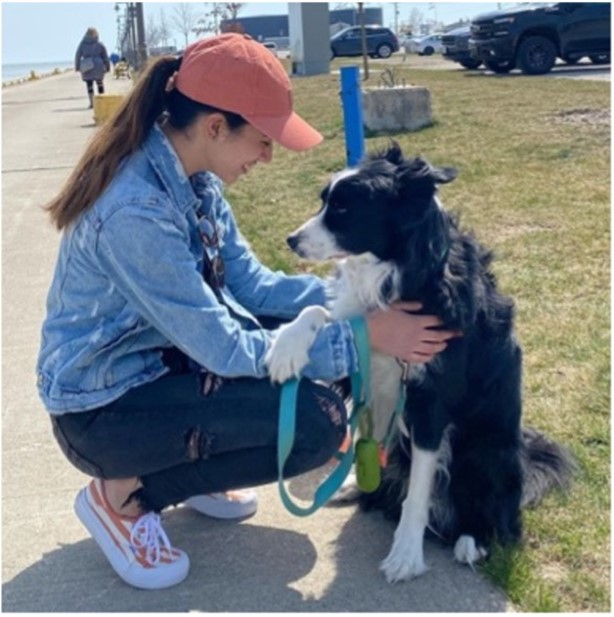
by Olivia Kroll
Have you ever wondered what women and gendered leadership look like?
I interviewed community leader, Val Torres, where we explored her leadership style, her intersectional identity, and power structures and discussed the influence of these factors on leadership. Val isn’t bound by traditional leadership boundaries. She exemplifies servant leadership and embraces leadership as “a two-way street”.
Meet Val Torres. Val is the Program Director of Young London, an organization seeking to “promote equity in community spaces by facilitating opportunities for young people to co-create solutions for meaningful impact in London” (Young London). Within Young London, Val facilitates programs and leads volunteers while building engaging connections. Through an interview with Val, I explored her leadership style. Val shared personal experiences that support the notion of women’s leadership as a labyrinth with obstacles and complexities unique to the individual.
Leadership as a “two-way street”. What does this mean?
Val defines leadership as a “two-way street” suggesting that leadership is “a dynamic relationship not just between the individual, but those who the individual is surrounding themselves with”. Val rejects traditional leadership styles that assume inherent systems of influence and instead values servant leadership, a style that shares the power and prioritizes helping others develop and enhance their skills (Austell, 2009). Throughout our interview, Val shared that effective leadership “doesn’t need to be that title position”. Val exemplifies leadership by prioritizing others, building relationships that focus on “priority over outcomes”, allowing others to speak first, and supporting and accentuating the skills of others.
Leadership as a “two-way street” is seemingly a modern view of leadership. The Deloitte Global 2022 Gen Z and Millennial Survey shows that Gen Z’s and millennials are “striving for balance and advocating for change”. This view challenges the hierarchical nature of traditional leadership styles. The survey shows millennials desire for participation and collaboration in decision making further supporting leadership as “a two-way street”.
Throughout the interview the concept of intersectionality arose as an eminent factor influencing women’s leadership.
Val shared her experiences as a young Latina woman who immigrated to Canada and how barriers such as gender, ethnicity, and age impacted her ability to assume leadership. Val shares, “when I came to Canada, and even now, I’m not Latina enough for some of my family because they’re like, oh, you grew up in Canada, you’re not Colombian, you don’t speak Spanish with an accent. But also growing up in school and people saying, you’re very clearly not white and an immigrant”. Val describes navigating her intersecting identities as walking “a tightrope”. Due to her intersecting identities Val often feels she needs to “work 10 times harder” to achieve success.
Women’s intersecting identities impact the way they view themselves and are viewed by others. Studies on intersecting identities in relation to leadership have described intersectionality as both an advantage and a disadvantage in women’s leadership. According to Wendy Smooth (2010), “Women who represent groups that have not traditionally held power are often situated within a paradox of power and oppression as leaders. At once, they can be both marginalized and empowered” (7). This holds true for Val and is a common experience among many women who are powerful by virtue but can be marginalized by cause of institutional life. Success entails navigating the effects of one’s intersecting identity and pushing back against stereotypes of both gender and power.
The influence of power structures resonated throughout the discussion. Everyone experiences power structures differently based on our individual experiences and diverse identities. For Val, leadership was presented in a traditional hierarchical structure. She says, “I saw leadership as you were given this position, it’s your title, it comes with roles, responsibilities, sometimes perks and that’s what leadership is”. But according to Val, this isn’t what leadership needs to be.
Often traditional power structures uphold the patriarchal status-quo and perpetuate inequality by promoting male dominance. Women are negatively impacted by traditional power structures including gender and cultural bias, and stereotyping. Women are expected to burden the “double shift”, taking on household and childcare responsibilities in addition to their paid jobs. Gender-power relations reinforce hierarchical power structures that drive inequality. In these environments, attempts to address, diversity, equity, and inclusion, often becomes tokenism. The result is underrepresentation of women in leadership positions, support of traditional beliefs, and continuation of the status-quo. So, how can women navigate power structures to support effective leadership?
Leadership Lessons from Val
- Recognize potential barriers
Aside from her position at Young London, Val works at a climbing facility. Val explained that she knew there would be challenges going into a male dominated industry, “not only as being Latina but also being a woman”. Identifying potential barriers is useful to inform decisions and strategic thinking. Val explains that recognizing barriers has allowed her to become more “tactile” in her approaches. Understanding one’s work culture and potential barriers will help navigating situations to ensure success.
2. Allyship – “Finding a friend”
Allyship fosters an inclusive environment with relationships bound by trust and accountability. Through Val’s experiences, she has used allies for support when she needed to amplify her voice. Allies can utilize their privilege and power to help advance the ideas of those without the same privilege. Additionally, allyship dismantles traditional power structures by building meaningful relationships and an equitable environment.
3. Passion
Lastly, Val highlighted passion as critical to leadership. Val has a passion for helping others and wanting others to feel respected. She includes “compassion and grace” to complement effective leadership. Leadership with passion creates ambition allowing leaders to motivate others to achieve a collective goal. Passion will not only enhance individual performance but will be observed by others and promote an empowered work environment.
You may still be wondering; how do women lead?
The answer, well it’s complex. Women’s leadership is a labyrinth with unique challenges and complexities. According to Val, leadership is “a two-way street” that requires awareness, allyship and passion. Women have broken the glass ceiling and proven that traditional approaches to leadership are not the only path to success. Women leaders have introduced collaborative and participatory leadership styles. That said, this approach is not the approach of all women. This bears the question: does an inherently “female” leadership style even exist?
 Women and Gender In Civic Leadership
Leave a comment